Resources Shared and Discussed
Throughout the episode, Rebecca repeatedly said, “Remind me and I’ll send that to you.” She is a lady of her word, here are the links and below you will find the Building your context information. I worked through the context exercise Rebecca recommended, it was a great help, at the time is was the consultant type version, Rebecca has since created a full set of prompts and for us provided an educator-context piece. You can complete the exercise is a google doc but if you are going to upload it to an AI tool of your choice we both recommend you download that file as a .md file and get use to working with those files – they are “cleaner” for AI work across all platforms.
- The Daily: The Battle Over A.I. in the Classroom
About teaching AI literacy a bit like driver’s education. It gets into the “rules of the road” idea and the curriculum the educator has built for students. - AmpED to 11
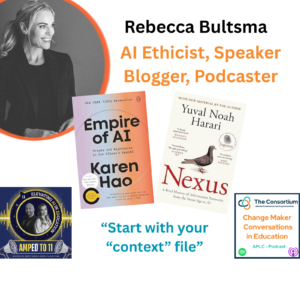
And this is our podcast! We talk with educators and people working around education who are trying to figure all of this out without treating technology as either magic or the end of the world. - Nexus by Yuval Noah Harari
I have read this more than once and keep coming back to it. It is about the stories and information systems that hold societies together, and what changes when AI starts producing those stories too. - Empire of AI by Karen Hao
Honestly, one of the best AI books I have read. It is investigative but still very readable, especially on OpenAI’s development, power, ideology, labour, and resource use. - The Infinity Machine by Sebastian Mallaby
I had just finished this one. Demis Hassabis and the story of DeepMind are fascinating, especially the AlphaFold work and the larger pursuit of superintelligence. - Oversold and Underused: Computers in the Classroom by Larry Cuban
This one is older, but that is partly why it is so interesting. We have been promising that technology will revolutionize classroom learning for a very long time, and Cuban asks whether it actually has. - Co-Existence: The Next Phase of AI by Ethan Mollick
One of my October preorders. You already know I appreciate Mollick’s work, and this one is about how we live and work alongside increasingly capable AI. - How to Be Good at Life by Ben Meer
Another October preorder. I like Ben’s systems-oriented way of thinking about health, productivity, organization, and life without pretending willpower fixes everything. - The AGI Chronicles by Kevin Roose
Also preordered. Kevin Roose is one of my favourite technology journalists, and this is his behind-the-scenes account of the race to create AGI. - System Sunday by Ben Meer
This is Ben’s newsletter. It is practical, systems-based, and usually gives you something you can actually use. - Hard Fork with Kevin Roose and Casey Newton
I listen every week. It is smart, current, funny, and one of the easiest ways to follow what is happening in AI and technology without drowning in it. - Yuval Noah Harari’s articles, interviews, and podcast appearances
I genuinely think listening to Harari explain and defend his ideas can be nearly as useful as reading the books. His site is the easiest place to find the various articles and appearances. - Yuval Noah Harari and Mustafa Suleyman on the future of AI
This is the conversation I mentioned. I love listening when people who think about AI from very different positions are actually in conversation with each other.
Prompt to Build an Educator-Context.md file for your work with AI – Copy and Paste welcomed”
Help me build an Educator-Context.md file that captures how I actually make decisions about teaching, learning, leadership, and student needs.
Interview me one question at a time. Do not give me a long questionnaire all at once. Use follow-up questions and specific scenarios to uncover:
- The experiences that shaped how I teach or lead
- What I believe good teaching and meaningful learning look like
- How I make difficult decisions involving students, staff, families, curriculum, technology, equity, assessment, and institutional constraints
- The evidence, research, authors, mentors, and ideas that influence me
- My non-negotiables, professional boundaries, and ethical concerns
- Where my stated beliefs and actual practices may conflict
- What energizes me, frustrates me, or makes me cautious
- How I want an AI assistant to support, question, and challenge my thinking
- What an AI assistant must never decide, assume, or write on my behalf
Push back when my answers are generic. Ask for examples, trade-offs, exceptions, and times when I changed my mind. Help me identify the professional judgments I make automatically but rarely explain.
When the interview is complete, organize my answers into a clear first-person context file. Preserve my language and perspective. Do not turn it into a polished biography, teaching philosophy statement, or generic list of best practices.
The finished file should help an AI tool understand my professional context and challenge my thinking without replacing my judgment or making decisions for me.
Create the final result as a downloadable Markdown file named Educator-Context.md.
And Then:
When it is finished, download Educator-Context.md and save it inside the AI Context Files folder on your desktop. You can update it whenever your role, thinking, or circumstances change, and upload it to future AI conversations when that context would be useful.
Our Guest for this episode is Rebecca Bultsma. Rebecca’s website shares a number of resources and recommendations for listening, reading, and trying as you navigate a bit of a new world with AI and, in our case, education. Presently, Rebecca is completing graduate work in the Ethics of AI at the University of Edinburgh in Scotland, travels the world presenting, and co-hosts a podcast AmpED to 11 (Apple and Spotify) of her own on AI and Education —many, many great episodes. You can follow her on LinkedIn. Rebecca lives, when not traveling for school, presentations, and just fun, between two communities, Calgary and Cardston, Alberta.