

How can we help educators support English as an Additional Language (EAL) learners without asking every teacher and school leader to start from scratch? For us, the answer begins with collaboration.
The APLC EAL Collaborative community’s Working Groups bring that commitment into resource development. Through this collaborative work, educators contribute their knowledge and perspectives to create resources that can be shared across Alberta through the EAL Toolkit.
From Shared Questions to Shared Resources
Supporting EAL learners involves connected decisions about programming, classroom instruction, assessment, and pathways through school. These decisions should not sit with one teacher or one specialist alone.
Collaboration provides an opportunity to ask important questions together: What do educators need? Where might language create barriers to participation? How can we make curriculum learning accessible while maintaining meaningful expectations? What support would help administrators make informed programming decisions?
The value of working together extends beyond producing a document. It creates space to consider different contexts, clarify language, and turn professional knowledge into practical tools. A resource becomes more useful when educators can see how it connects to the decisions they make every day.
The resources below were created by the APLC EAL Collaborative Community Working Groups. They offer starting points for these conversations—from school-wide programming to language development through subject-area learning.
Explore the Resources
High School Pathways Program Guide
Available on the EAL Toolkit’s Programming page, this guide focuses attention on high school pathways for EAL learners. It offers a starting point for bringing administrators, teachers, counsellors, and EAL support staff into a shared programming conversation. Consider using it during team planning to identify questions, examine learners’ circumstances, and discuss appropriate next steps.
Programming Guide for Administrators with EAL Learners K–12
This resource places EAL programming within the work of school leadership across Kindergarten to Grade 12. Administrators can use it as a starting point for staff discussion and shared planning. Read alongside the high school guide, it can help connect broader programming conversations with attention to secondary pathways.
Social Studies Curriculum Access Maps
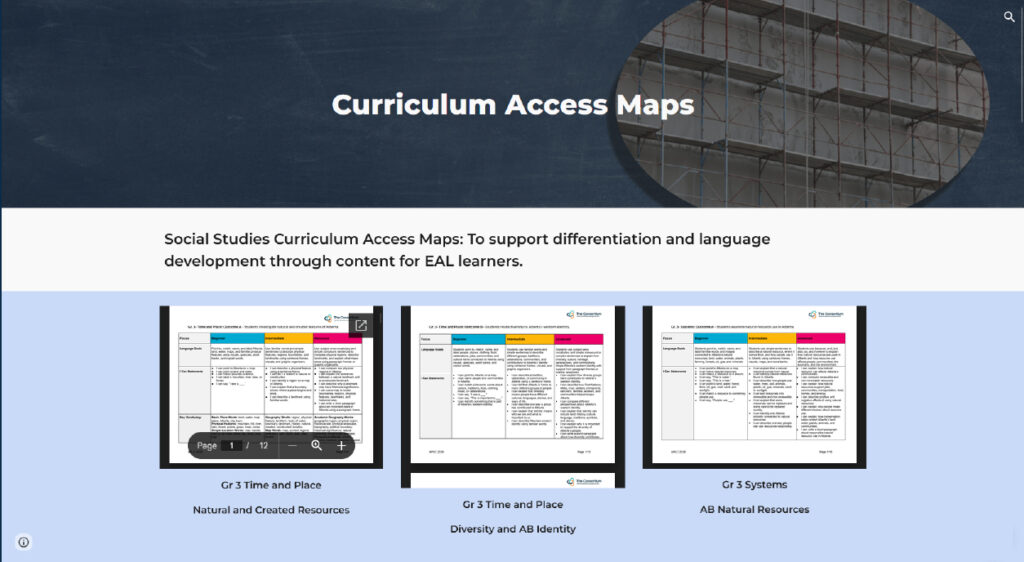 These resources support differentiation and language development through social studies content. The collection currently includes maps for Grades 3–6, addressing topics such as Alberta’s resources and identity, historical relationships, ancient civilizations, democracy, and citizenship. They provide a useful entry point for collaborative planning around curriculum access: What concepts are students learning, and what language will help them participate?
Rather than planning language support as an add-on, we encourage teams to consider it alongside curriculum learning. Teachers might examine an upcoming outcome together, identify essential vocabulary, and plan opportunities for students to discuss, represent, and explain their understanding. The goal is not simply to make a task easier; it is to make participation possible while supporting continued language growth.
A Collaborative Shout-Out: Writing Assessment Resources
We also want to recognize the collaboration between APLC and Rocky View Schools in sharing writing assessment resources.
K–11 Writing Continuum and English Writing Exemplars, Rubrics & Scoring Rationale
Developed by Rocky View Schools the APLC, this collection supports writing development and instructional decision-making. It includes a K–11 Writing Continuum, guidance for using the resource, and Grades 1–11 exemplars, scoring rationales, and year-long and year-end rubrics. The distinction is important: the continuum spans K–11, while the listed grade-specific materials cover Grades 1–11.
These materials offer a starting point for collaborative examination of student writing. We encourage educators to ask: What strengths can we identify? What is the student communicating? What would be a manageable next instructional step? For EAL learners, we also encourage teams to consider English language development, prior learning, and the supports available during the writing task.
Turning Resources into Professional Learning
Sharing a resource is an invitation—not the end of the work.
A school team might begin with one guide, one curriculum access map, or a small set of writing samples. Together, educators can identify a need, choose an approach, try it, and return to discuss what they noticed. What supported participation? What language did students use? What might we adjust?
The power of collaboration is that no single educator needs to hold every answer. By sharing expertise, asking questions, and building resources together, schools can strengthen their collective capacity.
About us
As Designers of Professional Learning, we support these collaborative conversations through online learning, in-person sessions, and on-site support to build educators’ capacity. Our work is guided by a shared commitment: helping schools create meaningful opportunities for EAL learners to participate, develop language, and demonstrate their understanding. Our aim is to help educators move from accessing resources to using them thoughtfully within their own settings.